
Honey in the Tea: A Self-Appreciation Practice for Educators
By: Salina Mae Espinosa-Setchko
Teacher Appreciation Week is here.
While appreciation is being offered in many ways, there’s something we don’t talk about enough: even when gratitude is present, it doesn’t always land.
At The Teaching Well, we’ve spent years working alongside educators navigating both the beauty and the intensity of this work. We know appreciation matters—and we also know that teaching lives in a constant state of duality: deep purpose alongside real strain.
So this week, we’re naming a practice we return to often: Let It Land. A simple but powerful shift—learning how to receive and integrate the good, even when it’s small.
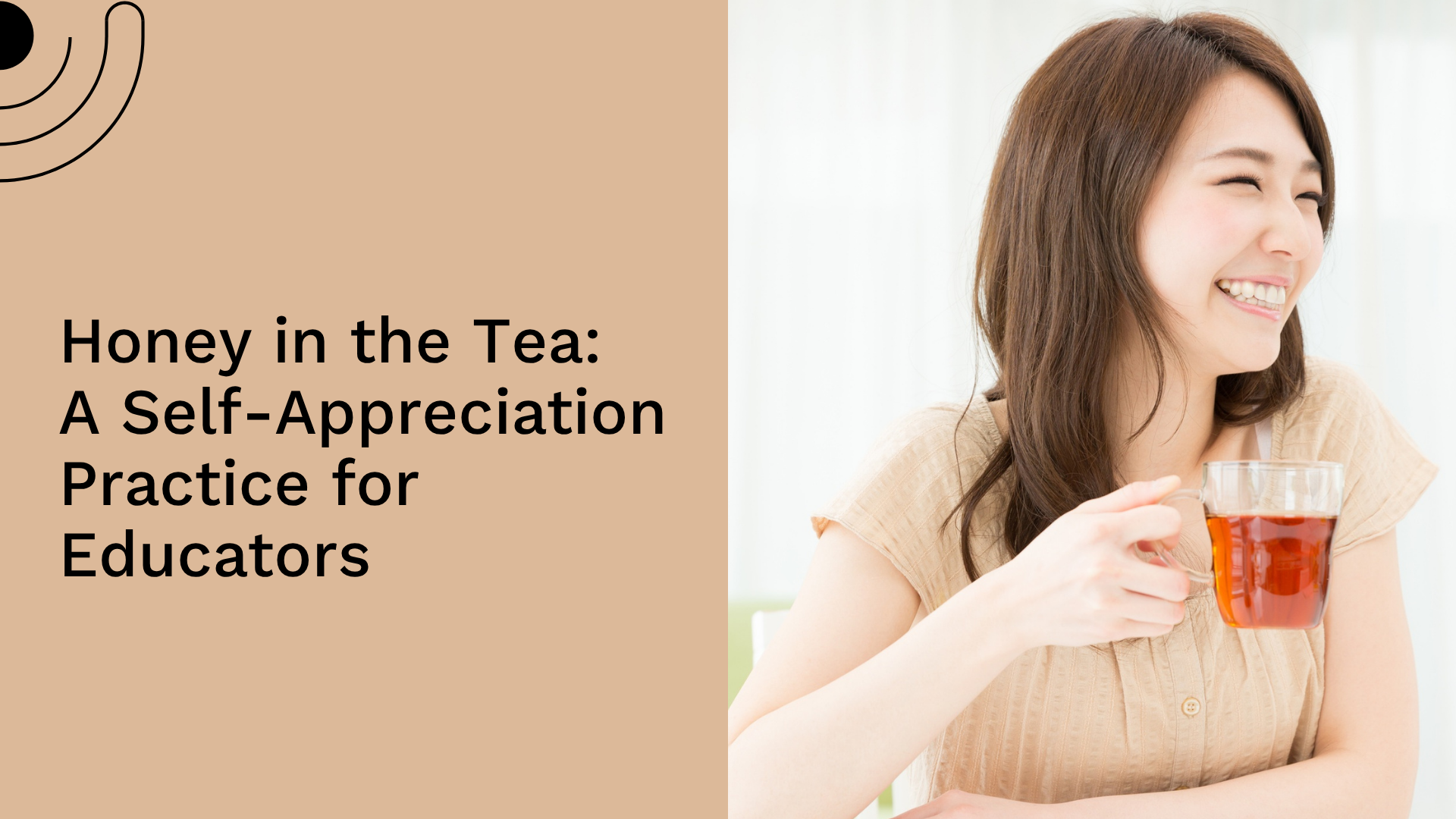
We often say that gratitude is like honey in bitter tea. It doesn’t remove the bitterness, erase the long days, the unmet needs, or the emotional labor, but it softens the edges. It makes what we’re holding more bearable. Teaching, like life, holds both.
This is something I came to understand in my own first grade classroom. At the time, I was moving through personal upheaval, teaching 34 students without an aide, and working with young people who carried both incredible brilliance and real challenges. I found myself hooked on everything that was going wrong and eventually started burning out.
But I loved those kids deeply so I tried to find another way. I started a simple daily practice of writing down what went right. Not big wins—small ones. For example:
Yesterday we made it through five minutes of a lesson; today we made it through seven. I sat down and actually ate lunch today. We laughed together. We sang, and for a moment, the room felt light.
Nothing about the external conditions changed overnight, but what I noticed did.
There’s a reason this practice works. Our brains are wired with a negativity bias. For survival, we scan for what’s wrong, what’s missing, or what might go wrong next. Psychologist and neuroscientist Rick Hanson describes it simply: “the brain is Velcro for the bad and Teflon for the good”. The hard moments stick while the good ones slide by.
So even when appreciation is offered—or when something genuinely goes well—it may not register. The practice of letting it land interrupts that pattern.
When we pause and savor a positive moment for even 10 to 20 seconds, we help the brain encode it. Over time, this builds new neural pathways—not to ignore the hard, but to become more resourced in the face of it.
At The Teaching Well, we don’t just name ideas—we practice them. So we invite you to try on something simple. Think of one small moment from your week and notice what happened. Then gently ask yourself, What did I bring to that moment? See if you can stay with that for 10 to 20 seconds, letting it register.
That’s it. Simple. Not always easy, but powerful over time.
You might also support this with a daily reflection or gratitude list—not as a way to force positivity, but as a way to remind your mind that there is more here than just what’s hard. You might ask yourself:
What’s one moment this week that mattered, even a little? What did I bring to that moment? What might change if I let that count?
You deserve to be seen for the care you give, the energy you expend, and the ways you show up in work that is both demanding and deeply meaningful–even if you are the only one seeing it.
That’s why this practice matters. Because when you begin to receive—even a little—you expand your capacity to hold it. You build an internal landing pad where the good can take root. Not instead of appreciation, but alongside it.
The bitterness… and the honey.
Today, see if you can let even one drop of honey land. If you’d like support in this practice, you’re invited to listen to a guided meditation, Let It Land: Honey in the Tea, where I lead you through this experience step by step.