
Starting the School Year with Intention: 3 Sustainability Practices to Carry This Year
By: Erika Haro, Clinical Therapist
The Sunday Scaries, or Sunday Blues, aren't always confined to the weekend. For many educators, those feelings of dread, anxiety, or uneasiness begin to surface weeks before returning from summer break.
It can feel like a jump scare as you're relaxing at home, enjoying a show in the middle of the day, when during the school year you'd be supervising lunch duty. Suddenly, a high-energy commercial bursts onto the screen: "School is back in session!" Before you know it, your mind is racing and you're flooded with emotions that range from excitement and anticipation to stress or even panic. Those emotions are real and they're understandable.
Working in a school environment is complex. Every day requires you to balance the academic, social, and emotional needs of students while managing countless responsibilities behind the scenes. While the work may never feel "easy," there are intentional practices that can help create greater sustainability throughout the school year in order to support both your general wellbeing and your mental health. Small changes, practiced consistently, can lead to meaningful benefits over time.
Commit to Real Breaks
One of the most impactful habits educators can build is taking intentional breaks. That means more than eating lunch while answering emails, supporting students who stop by your room, and sending a quick message to a parent. A true break means giving yourself permission to prioritize your wellbeing, even if it's only for 30 minutes.
It's okay to close your door, step away from your responsibilities for a moment, and allow yourself some quiet time to reset. Those moments can help you return feeling more grounded and more aligned with the educator you strive to be.
If taking a true break every day doesn't feel realistic, consider choosing two or three days each week that are non-negotiable. Over the course of a school year, that could mean 75 to 100 days where you intentionally chose your wellbeing. Imagine the difference that could make.
Reset Before You Leave Work
Another powerful practice is creating space to reset before transitioning from school to home. Throughout the day, educators are immersed in constant stimulation, you hear your name called dozens of times, hear the latest social media catchphrase repeated all day long (goodbye 6-7), and try to answer a student's question while announcements play over the loudspeaker. By the end of the day, it's no surprise that many educators feel mentally drained, emotionally exhausted, or overwhelmed. Without intentional recovery, those feelings can easily spill over into the rest of your life.
And then there are the heavier days. The days when a student shares something that requires involving admin, a school counselor, or a social worker. The days when difficult conversations, unexpected situations, or emotional moments stay with you long after the last bell.
Those experiences take a toll, which is why creating opportunities to reset is a necessity.
Your reset might include:
Sitting quietly for five to ten minutes and taking a few slow breaths.
Following along with a five-minute guided meditation.
Watching a few funny videos (especially funny pet videos), laughter releases endorphins that help reduce stress.
Listening to a song that brings you joy.
Writing down any unfinished tasks so you can mentally release them instead of carrying them home.
Drinking water or having a snack before heading home to help regulate your body after a demanding day.
The goal isn't to erase the stress of the day, it's to create enough space so you don't carry all of it into your evening with family, friends, pets, etc.
Practice Gratitude, Especially Toward Yourself
Practicing gratitude not only supports stress management but can also rewire your brain by creating new positive neural pathways. Research suggests that it can help manage stress and strengthen positive neural pathways in the brain. Even more powerful is practicing gratitude toward yourself.
Self-gratitude can help build self-esteem, increase self-compassion, and remind you that your worth isn't determined by a single lesson, a difficult day, or a challenging interaction. That's especially important during the school year where there will be weeks when your lesson didn't go as planned, times when you wonder whether you did enough in your role and days when personal challenges affect how you're able to show up. During those moments, self-compassion will be the roots that ground you.
A simple practice is to write down one thing you appreciate about yourself each day. It can be on a sticky note, in a journal, or in the notes app on your phone. Over time, those small reminders create a record of your strengths, the times you showed up for yourself, or the little things that get overlooked. It’s a space you can return to when self-doubt begins to creep in but more importantly, it can shift your perspective and enhance your wellbeing throughout the year.
As educators, you spend so much time encouraging, supporting, and believing in your kiddos. This school year, remember that you deserve that same care and compassion. Taking care of yourself isn't separate from taking care of your students, if you are well, you can increase your capacity to help them also be well.
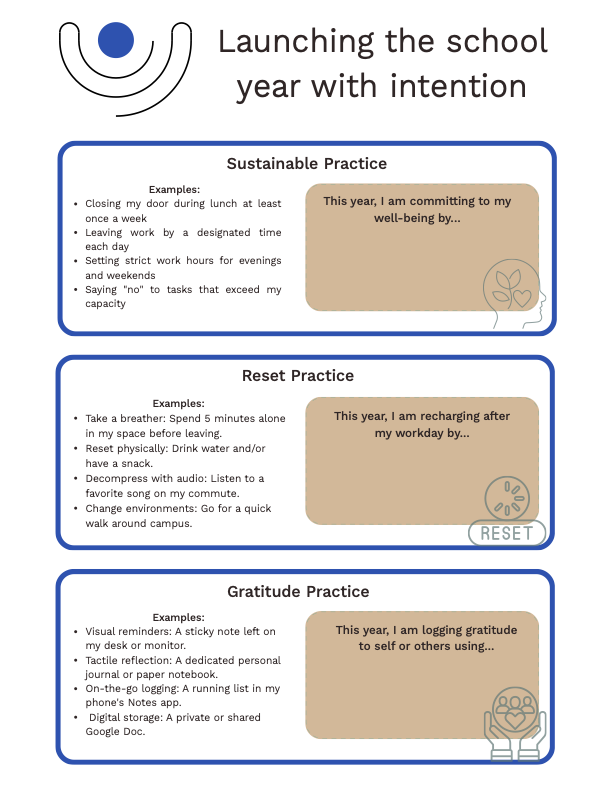
These are just a few practices to carry into the school year. We encourage you to choose or find just one intentional practice that will bring you more sustainability this year. Feel free to utilize our guiding worksheet to set some intentionality for this year!
Click the image to download the worksheet
Resources
“Self-compassion, Gratitude, PERMA-based Well-being, and Anxiety” hosted on the National Institutes of Health PubMed Central.
“Do gratitude and self-compassion moderate the relationship between perfectionistic concerns and mental health outcomes?” published on PubMed.
“Does gratitude rewire your brain?” published by American Brain Foundation.